
Soil Testing for Horse Pastures in Georgia: Smarter Small Acreage Management in 2026
This post may contain affiliate links. If you purchase through these links, I may earn a small commission at no additional cost to you. As an Amazon Associate, I earn from qualifying purchases. I only recommend products, services, and resources that I personally use, trust, or believe may provide value to my readers.
•••
If you're managing a horse pasture, homestead, or small acreage property in Statesboro, Southeast Georgia, or anywhere in the Georgia Coastal Plain, soil testing is one of the most valuable tools available. Understanding your soil's pH and nutrient levels can help you choose the right pasture grasses, apply fertilizer more effectively, and avoid wasting money on seed that simply isn't suited to your land.
For the past two years, I've been in what I lovingly call "panic planting mode."
Translation: I've thrown a lot of grass seed at my pasture and hoped for the best.
My goal has always been simple: provide my horse and mini mule with a little snack pasture—something green for vitamin E, enrichment, and variety. Have I been wildly successful? Not exactly. But I've been successful enough to start noticing patterns.
My lower field near the swamp absolutely thrives on Red River crabgrass. It stays a little more moist and benefits from some afternoon shade. The upper paddock, however, clearly prefers Bermuda grass.
Same property. Different conditions. Different results.
That was my first clue.
This year, now that my brain is no longer operating in constant emergency management mode, I decided to do something revolutionary:
I tested the soil.
Why Soil Testing Matters for Horse Pastures and Small Acreage Properties
When you're managing one to one-and-a-half acres, every decision matters.
You don't have unlimited acreage to rotate through. You don't have room to repeatedly guess wrong. Every bag of seed, every fertilizer application, and every management decision has a bigger impact.
Soil testing helps:
Save money on unnecessary fertilizer
Identify nutrient deficiencies before they become problems
Determine which grasses are most likely to thrive
Improve forage production
Reduce frustration and repeated reseeding efforts
Support long-term pasture health
For horse owners in South Georgia, soil conditions can vary dramatically even within a single property. Sandy soils, seasonal drought, heavy summer rains, drainage differences, and varying levels of shade all influence what grows best.
As it turns out, blindly throwing seed at dirt is not a long-term management strategy.
Option 1: Soil Testing Through Your Local Extension Office
If you're located in Statesboro, Bulloch County, or elsewhere in Southeast Georgia, your local University of Georgia Cooperative Extension office is often the most affordable and reliable place to start.
And when I say it's affordable, I mean it's dirt cheap.
Soil tests start around $6 and provide recommendations tailored specifically to:
Your soil
Your geographic region
Your intended use
Your nutrient levels
Whether you're managing a horse pasture, hay field, lawn, garden, food plot, or homestead, the recommendations are based on Georgia-specific research and growing conditions.
If you're looking for the simplest and most accurate option, this is the route I'd recommend.
Option 2: The DIY Science Class Experience
Of course, if you're like me and see a soil test kit sitting on a Walmart shelf and think:
"I would like to feel like I'm back in sixth-grade science class again."
That's an option too.
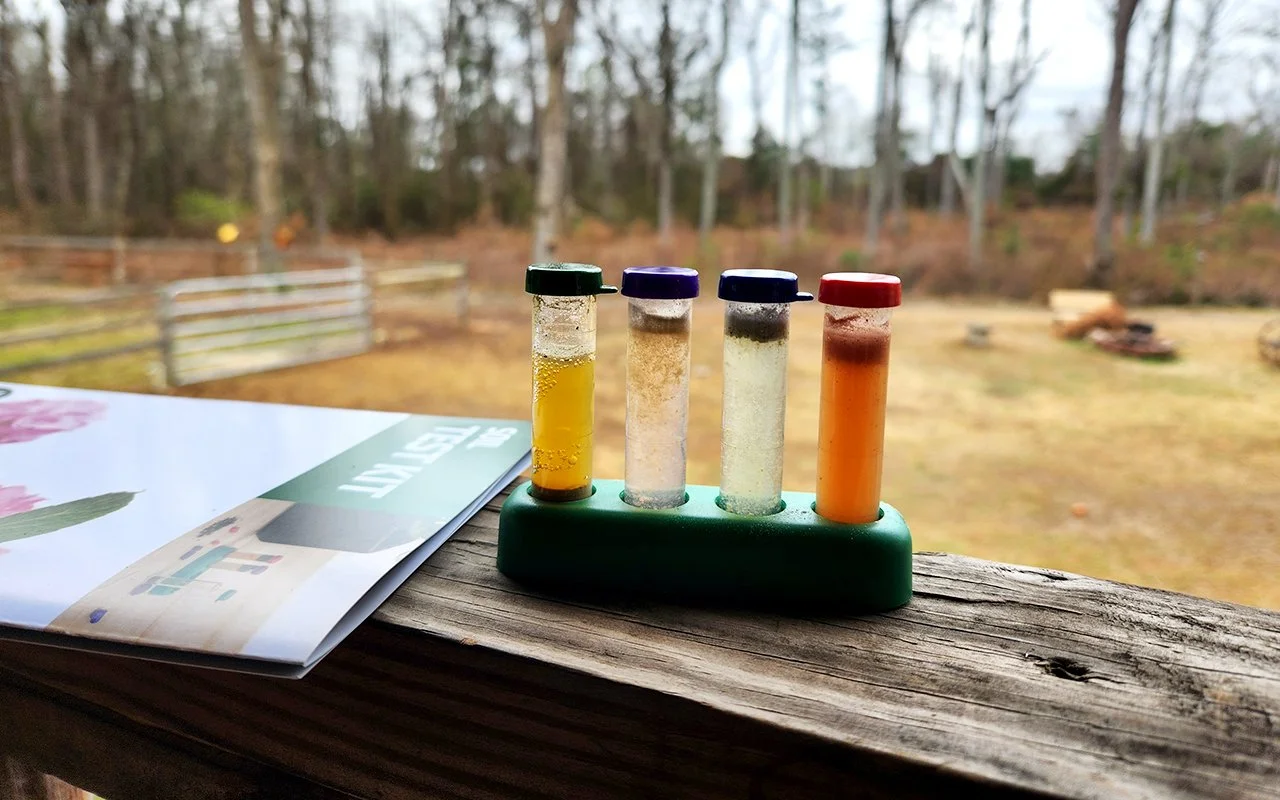
I may or may not have purchased one.
Did I accidentally mess up the first test because I didn't make a proper dirt slurry and let it settle correctly?
Yes.
Yes, I did.
The second attempt went considerably better.
My results showed:
pH: 6.5
Very low nitrogen
Very low phosphorus
Low potash
That explained a lot.
While a pH of 6.5 is generally suitable for many pasture grasses grown in Georgia, the nutrient deficiencies helped explain why some of my previous pasture establishment attempts had struggled.
Even grasses that are well-adapted to South Georgia's climate still need adequate nutrients to establish healthy root systems and produce quality forage.
If you’d like to participate in the 6th grade science experiment, here’s a good one from Amazon.
Choosing the Right Grass for a Horse Pasture in South Georgia
One of the biggest lessons I've learned is that not every section of a property wants to grow the same thing.
My lower field naturally favors Red River crabgrass because of higher moisture levels and partial shade.
My upper paddock consistently performs better with Bermuda grass.
Rather than fighting what nature is already telling me, my 2026 plan is to work with those conditions instead of against them.
For many horse owners in Southeast Georgia, warm-season grasses such as:
Bermuda grass
Crabgrass
Bahia grass
often provide the most reliable performance due to their ability to tolerate heat, humidity, grazing pressure, and seasonal drought.
Understanding what naturally thrives on your property can often be just as valuable as any recommendation you'll find online.
So Now What?
This is where 2026 gets interesting.
You can:
Deep dive into Google
Call your local Extension office
Ask the knowledgeable person at your feed store
Read pasture management resources
Or use modern technology wisely
So I did what any curious small acreage owner would do.
I consulted ChatGPT.
And before anyone panics, I didn't simply type:
"Fix dirt."
I provided:
My location in Georgia
Acreage size
Soil test results
Intended use (horse pasture)
Drainage conditions
Existing vegetation
Pasture goals
The recommendations were surprisingly practical:
Use Bermuda grass as the primary pasture grass
Supplement with crabgrass where it naturally thrives
Apply a balanced fertilizer such as 10-20-20 or 13-13-13 in early spring
Seed in April
Apply nitrogen boosts in May and July
Structured.
Seasonal.
Logical.
And perhaps most importantly, aligned with what I was already observing on the ground.
Small Acreage Reality
Many pasture management resources are written for large horse farms managing dozens or even hundreds of acres.
Small acreage owners face a different reality.
When you're managing one to two acres, every square foot matters.
Soil compaction happens faster.
Overgrazing becomes more noticeable.
Drainage issues become more obvious.
Mistakes become more expensive.
Whether you're caring for one horse, a mini mule, or a small herd, understanding your soil is one of the highest-return investments you can make.
For small acreage horse owners, soil testing isn't just a useful tool.
It's one of the best management decisions available.
The Bigger Takeaway
We have access to more information in 2026 than we did even a few years ago.
Whether you:
Use your local Extension office
Grab a DIY soil test kit
Ask your feed store expert
Consult modern technology
Or combine all of the above
The information is there.
The challenge isn't finding information anymore.
It's using it.
Sometimes the difference between a struggling pasture and a thriving pasture isn't more fertilizer.
It isn't more grass seed.
It isn't a fancy pasture blend.
Sometimes it's simply understanding your dirt.
And honestly, that's probably where I should have started two years ago.
Happy planting, friends.
Frequently Asked Questions About Soil Testing Horse Pastures
How often should horse pastures be soil tested?
Most Extension offices recommend testing every two to three years or before establishing a new pasture.
What is the best grass for horse pastures in Georgia?
Bermuda grass is one of the most commonly used pasture grasses in Georgia due to its drought tolerance, durability, and ability to withstand grazing pressure. Depending on conditions, crabgrass and Bahia grass may also perform well.
Is soil testing worth it for small acreage properties?
Absolutely. Small acreage owners have less room for error, making soil testing one of the most cost-effective pasture management tools available.
Can I soil test my pasture myself?
Yes. DIY kits can provide useful information, but Extension Office testing generally provides more accurate results and fertilizer recommendations tailored to your region and intended use.
Affiliate Disclosure
Some of the links on this website are affiliate links. This means that if you click on a link and make a purchase, I may receive a commission at no additional cost to you.
As an Amazon Associate, I earn from qualifying purchases. I may also participate in other affiliate programs that provide compensation when products or services are purchased through links on this website.
My goal is to provide honest opinions, recommendations, and information. Any compensation received through affiliate programs does not influence the content, topics, or products I choose to feature. I only recommend products, services, and resources that I personally use, have experience with, or believe may be valuable to my audience.
Your support through these affiliate links helps maintain this website and allows me to continue creating helpful content. Thank you for your support.
