
Outdoor Oyster Mushroom Towers: An Experiment in Straw, Fencing, and Questionable Decisions
I have been growing oyster mushrooms indoors for a while now, which naturally led me to the next logical question: how can I reduce waste from contaminated blocks and “spent” blocks, while potentially growing more mushrooms in a less tedious way?
This led to a Google search for easy DIY vertical towers for mushrooms and how to use spent blocks to colonize substrate.
Bingo. The results were inspiring.
So, what happens if I put them outside in a homemade tower made out of horse fencing and straw?
There was only one way to find out.
So, in the name of agricultural science—or at least my particular version of it—I built a few outdoor oyster mushroom towers here at Circle WM Land & Livestock, courtesy of the concrete pad that stores all of my odds and ends of fencing and roofing that might be useful one day.
The Highly Sophisticated Mushroom Tower
The construction materials were refreshingly simple, albeit slightly miserable to do in the 100-degree heat.
I took pieces of 2x4 woven horse fencing, cut them to size, rolled them into tubes, and tied the ends together. Nothing fancy. Nothing purchased specifically for mushroom cultivation. Just farm materials being reassigned to a new department.
For the growing medium, I used local wheat straw from the feed store. It was roughly $9 for a 50lb bale. Refreshingly cheap for one of my projects.
The straw was hydrated and lime-pasteurized using hydrated lime, also from the feed store, in a few of my old muck buckets. The hydrated lime was $5 and was plenty for at least 10-15 towers. Once again, I felt like a real winner with these prices and convenience.
The buckets were cleaned first.
I have standards, believe it or not.
Once the straw was ready, I stuffed cardboard into the bottom of each fencing tower to keep everything from immediately falling out, then started filling the tower with alternating layers of hydrated straw and colonized oyster mushroom grain spawn.
The recommended approach is generally to chop the straw into shorter pieces first.
Did I do that?
No.
That sounded like additional work and too messy for my liking.
Apparently the Pink Oysters Didn't Read the Instructions
The first tower was inoculated with pink oyster mushroom grain spawn.
Pink oysters like warm weather, which makes them one of the more interesting candidates for outdoor summer growing here in southeast Georgia. Even so, we're currently dealing with days hovering around 100°F.
The towers are tucked into a heavily wooded, shaded area where they're protected from direct sunlight and can take advantage of whatever cooler, more humid microclimate the trees are willing to provide.
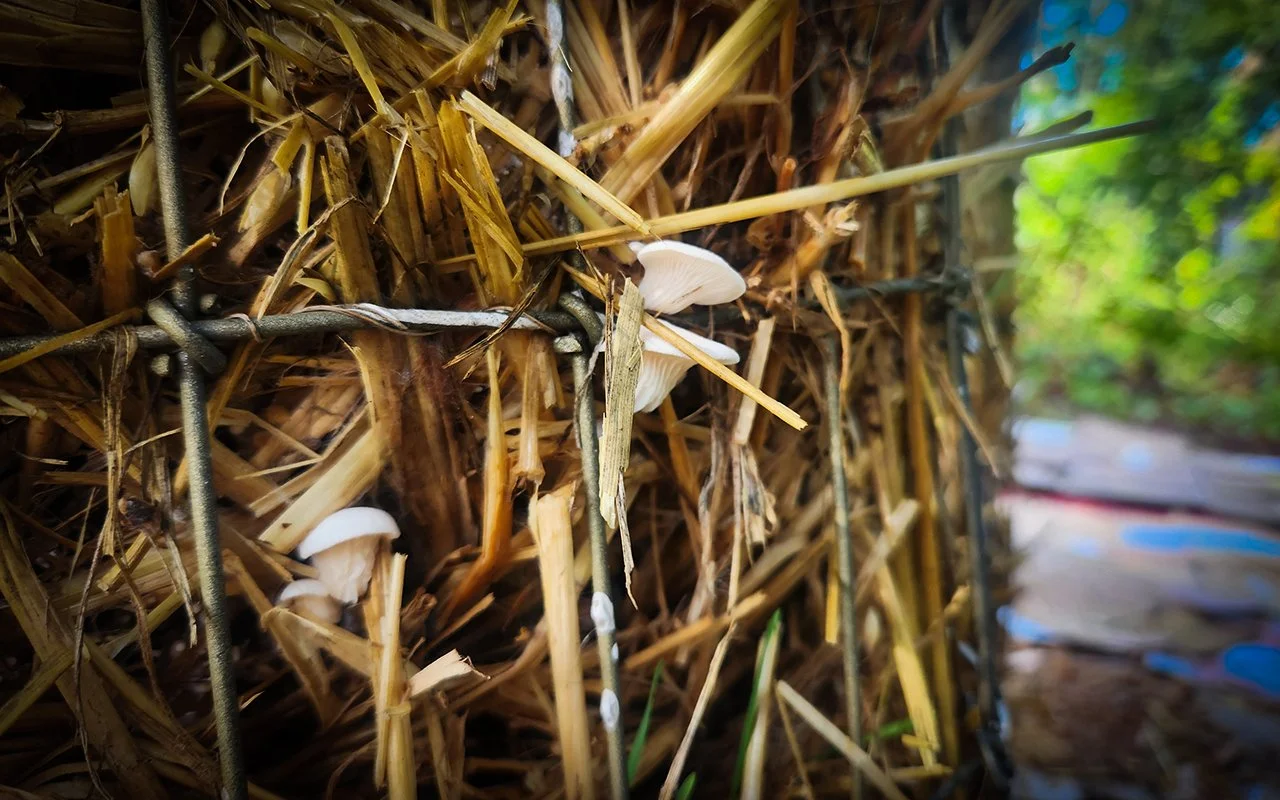
And, approximately 2½ weeks after building the tower, pink oyster mushrooms started popping out.
Not just one sad little mushroom, either. I'm seeing pins and clusters appearing in multiple places around the tower.
So apparently the pink oysters have the tenacity to make up for my inability to chop straw.
I'll take it.
Then I Started Throwing Old Mushroom Blocks Outside
Because one successful questionable decision inevitably leads to several more, I also made a blue oyster tower and a King Black oyster tower.
Instead of fresh grain spawn, these were experiments in recycling.
I had spent mushroom fruiting blocks from my indoor grow tent that were still well colonized with healthy-looking mycelium. Rather than immediately composting them, I broke them up and incorporated them into straw towers.
Will they recolonize the straw?
Will they produce another flush?
Will they quietly become expensive compost?
No clue.
That's the experiment.
Unlike a clear plastic mushroom bag, I can't exactly see what's happening inside a cylinder packed with straw. For now, I'm keeping them moist, leaving them alone, and occasionally staring at them and quietly cheering them on.
Outdoor Mushroom Maintenance, Circle WM Style
The towers don't receive much attention.
They're kept in the shade under the trees, where they're protected from direct summer sun. If we haven't gotten rain, I lightly hose them down about three times per week, adjusting as needed depending on the heat and Mother Nature's willingness to precipitate.
I'm trying to keep the straw moist without keeping the entire thing permanently waterlogged and moldy.
There are also bugs.
Lots of bugs.
This is southeast Georgia in summer. Pretending otherwise would be dishonest.
So far, however, they don't seem particularly interested in destroying the mushrooms. I'm sure someone will eventually discover them, but for now we're peacefully coexisting.
A Note Before You Build a Mushroom Tower in August
Just because my pink oysters are fruiting outside during a Georgia summer does not mean every oyster mushroom will.
"Oyster mushroom" covers a surprisingly large group of mushrooms and strains with very different temperature preferences.
Pink oysters are heat lovers. Many blue and pearl-type oysters prefer significantly cooler weather. King and Black King/Black Pearl types generally favor cooler fruiting temperatures as well.
Even mushrooms sold under the same general name can have different temperature ranges depending on the strain selected by the spawn producer.
Read the fine print from whoever you're buying your grain spawn from.
Don't just look at today's temperature, either.
Think about the entire growing window:
inoculation → colonization → first flush → recovery → second flush
If you're starting an outdoor tower, you ideally want the weather to cooperate for that whole process—not just the Saturday afternoon when you happen to build it.
Rough Outdoor Oyster Mushroom Calendar for Southeast Georgia
This is a general starting point, not a guarantee. Southeast Georgia weather has never shown much interest in following calendars, and the exact strain you purchase should always outrank this chart. Here’s my rough planner of how I’ll be attempting towers over the next calendar year.
Pink Oyster
Best outdoor window: May–September
Pink oysters are the obvious summer candidate. They generally prefer warmer fruiting conditions, often around 70–80°F, although specific strains vary.
For southeast Georgia, I'd consider late spring through summer their main outdoor season. July and August can still push well above their ideal range, so deep shade and moisture become especially important.
My experimental verdict so far: If they're producing in my straw tower during August, they're at least willing to negotiate.
Italian Oyster
Best outdoor window: March–May and September–November
Italian oysters (Pleurotus pulmonarius) tolerate somewhat warmer conditions than many classic cool-weather oysters. Some commercial strains fruit around 65–75°F.
That makes them interesting for our shoulder seasons—spring and fall—when daytime temperatures are warm, but we're not consistently roasting.
Summer White Oyster
Best outdoor window: April–October
This one is particularly interesting for southern growers because certain Summer White strains have a much broader fruiting range. Field & Forest, for example, lists its Summer White strain at roughly 45–85°F.
I'd still rather establish a tower before the worst July/August heat arrives, but this could be one of the better options for stretching an outdoor oyster season in Georgia.
Blue Oyster
Best outdoor window: November–March
Blue oysters are cool-weather mushrooms.
Some blue strains produce their best color around 60–65°F, while other P. ostreatus strains are listed around 55–68°F.
In southeast Georgia, that makes late fall through early spring much more attractive than summer.
Which makes my August blue oyster tower particularly scientific.
By "scientific," I mean I put it outside, and now we're going to see what happens.
Pearl/Grey Oyster
Best outdoor window: October–April
Most classic Pleurotus ostreatus strains prefer cooler fruiting conditions, often somewhere in roughly the 50s through upper 60s depending on the strain.
For us, these make much more sense as fall, winter, and early-spring outdoor mushrooms.
King / Black King / Black Pearl Oyster
Best outdoor window: November–March
These are another cool-weather project.
King trumpet (Pleurotus eryngii) generally prefers fruiting temperatures around 50–65°F, while some Black Pearl strains prefer an even narrower cool range.
They also aren't necessarily the best candidates for traditional straw-tower cultivation compared with other oysters. Some commercial Black Pearl strains specifically prefer supplemented sawdust.
Did that stop me from putting spent blocks into a straw tower?
It did not.
Again: experiment.
So, Does It Work?
Pink oyster tower?
Yes. Apparently.
Blue oyster tower?
We'll see.
King Black oyster tower?
Also we'll see.
And that's really the point.
The materials were inexpensive. The straw came from the feed store. The fencing was ordinary farm fencing. The buckets were already here. Two of the towers gave spent mushroom blocks another opportunity to produce something before eventually becoming compost.
If they produce mushrooms, excellent.
If they don't, I'll have learned something.
Either way, I'll keep watching the towers over the next few months and report back on what fruits, what doesn't, what gets eaten by bugs, and what turns into an elaborate cylinder of compost.
Sometimes farming is carefully following established best practices.
Sometimes it's putting mushroom spawn inside a tube of horse fencing and seeing what happens.
