
One of my favorite things about farming is realizing that something you’ve been throwing away might actually be useful somewhere else.
I recently came across the work being done by Hernshaw Farms in West Virginia, where spent mushroom blocks are used as part of their effort to rebuild former coal mine land into usable farmland.
Naturally, my first thought was:
Well, I have spent mushroom blocks. And I definitely have some dirt that could use some help.
So, here we go.
The Problem: My Pasture Is Slowly Becoming a Beach
Circle WM sits on a rural dirt road in South Georgia, which means sand and red Georgia clay are simply part of life around here.
Unfortunately, heavy rain also means some of that material washes off the road and into portions of my horse pasture.
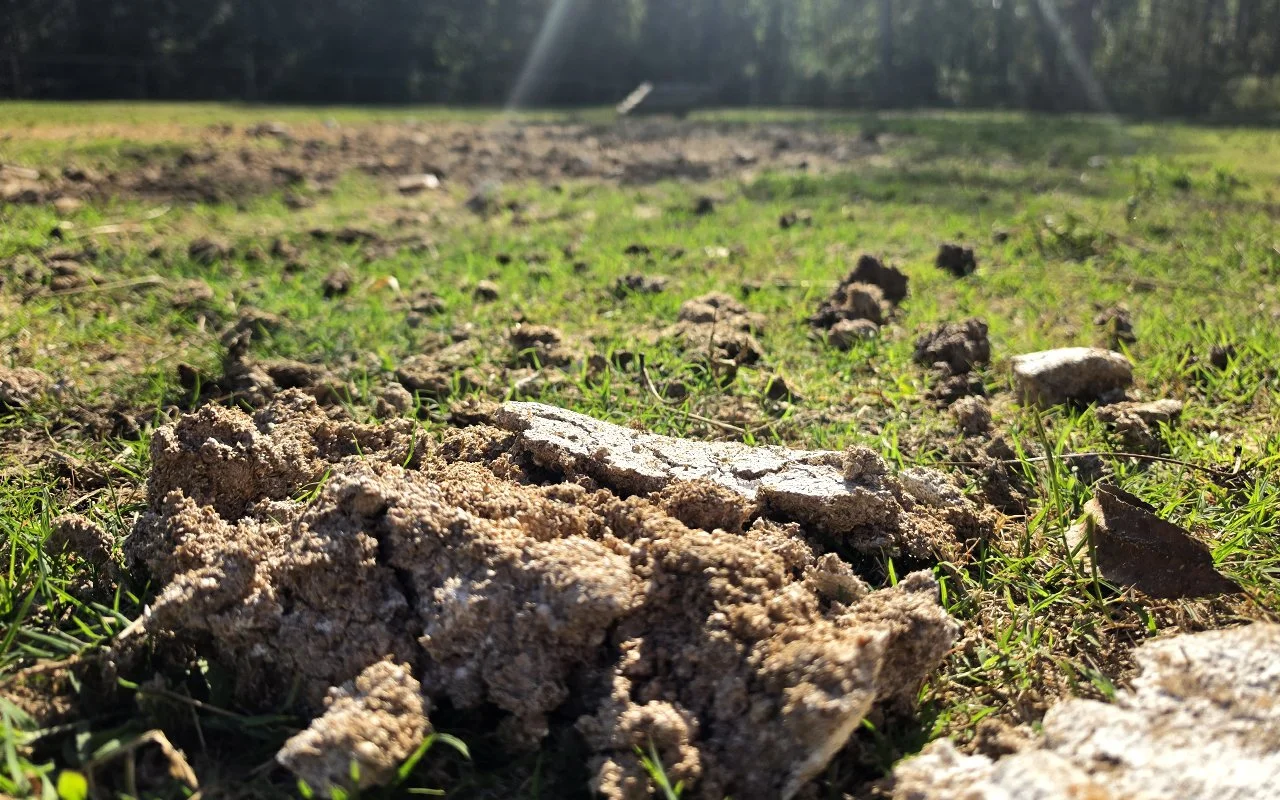
Over time, I've developed several areas where the existing pasture soil has essentially been buried beneath fresh deposits of sand and clay. Some spots are particularly sandy and almost completely grassless.
Grass doesn't have much incentive to grow there.
I've tried some of the usual approaches, but rebuilding soil takes time—and constantly buying and hauling in amendments isn't exactly my favorite solution.
Meanwhile, my mushroom operation produces something on a regular basis: spent mushroom blocks.
What Exactly Is a Spent Mushroom Block?
My mushrooms are grown on blocks containing organic material—primarily hardwood-based substrate along with other ingredients that provide nutrition for the mushrooms.
Eventually, the mushrooms take what they're going to take from the block, and production drops enough that keeping it in the fruiting tent no longer makes sense.
At that point, it's "spent."
But spent doesn't necessarily mean useless.
There is still a substantial amount of organic material left behind, healthy and strong mycelium networks, along with partially decomposed wood and fungal matter.
And that's where things get interesting.
From Coal Mine to Horse Pasture
Hernshaw Farms' work got me thinking about my own little patch of Georgia.
Obviously, a sandy horse pasture and reclaimed coal mine land are two very different situations.
But the basic question is remarkably similar:
Can a waste product from mushroom production help put organic matter back into poor, disturbed soil?
Research into spent mushroom substrate suggests it can be useful as a soil amendment. Adding organic matter can improve soil structure, encourage biological activity, provide nutrients, and help grass establish in marginal soils.
That's exactly what some of these sandy areas are missing.
So instead of hauling my spent blocks away or simply tossing them into a compost pile, I'm going to start experimenting with putting some of them back into the farm.
The Experiment
The plan is pretty simple.
I'll break apart spent blocks and allow the material to further break down before incorporating it into some of the worst sandy areas of the pasture.
Then we'll see what happens.
I'm particularly interested in watching:
Whether the amended areas hold moisture better
Whether grass establishes more readily
How quickly the mushroom substrate breaks down
Whether there is a noticeable difference between treated and untreated sandy areas
Whether repeated applications begin creating something that actually resembles decent topsoil
I'm not expecting a spent mushroom block to magically turn deep sand into rich pasture overnight.
But if I'm already producing this material as a byproduct of growing food, and it can help rebuild another part of the farm rather than becoming waste, that's an experiment worth trying.
I'll document the process, take photos, and compare how the amended areas perform as the pasture grows.
Stay tuned for the results.
